
 |
||
|
 |
Welcome to 100+ years of Venice History ~~~ Visit the Calendar Page. We have a Holiday Fair this weekend.
~~~ Consider contributing to the Venice Historical Society. ~~~ Peruse Our Store for Colorful One-of-a-Kind
~~~ DONATE TO OUR SPECIAL FUNDRAISING CAMPAIGN! ~~~ Visit the Venice Historical Society on Facebook! ~~~
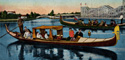
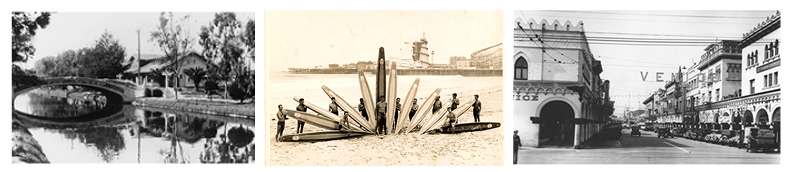
After his marriage in 1884, Kinney began purchasing land to the south with Francis Ryan. The partners developed Ocean Park with a walk pier and a country club. A streetcar line was extended to the site. After Ryan's untimely death in 1898, and a succession of partners with whom Kinney couldn't agree, it was decided that the land speculator would toss a coin and the winner would choose which half of the district would be his. When Kinney won the toss, he startled the other four partners by choosing the barren, marshy property. Kinney soon announced that his sand dunes and marshland would soon be a cultural city patterned after Venice, Italy. The public laughed and dubbed the plan "Kinney's Folly". They stopped laughing when trenches for canals were dug and Venetian-patterned buildings began to spring up. By July 4, 1905, Venice-of-America officially opened with a wonderful pier and exciting attractions: Italian gondoliers poling their boats down fairy-lit canals, a concert orchestra supplying music that could be heard nearly all over town, camel rides, exotic hotels catering to the best tastes and a miniature railroad circling the entire scene. The cultural diversion never flourished in Venice. The public came to ride the camels and the little train and to see the sideshow. The Doge of Venice-of America had built a cultural Renaissance by the sea. This atmosphere still prevails today. |












|
|
