
 |
||
    |
|
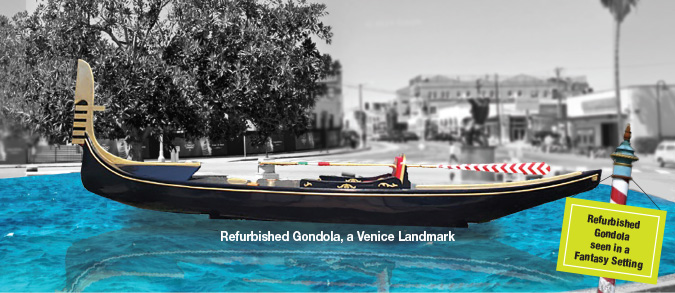
The Venice Historical SocietyCommemorating the 40th Anniversary of the Venice Historical Society along with the Venice Stakeholders Association invites you to a celebration and fundraiser of the refurished Venice Gondola
Join us on Sunday, September 13th from 5:00 to 7:00 pm at Hama Sushi Restaurant & The Gondola Garden 213 Windward Circle, Venice, CA Adjacent to Windward Circle. Sonya Reese Greenland, granddaughter of Arthur Reese, creator of the historic gondolas, will be talking about the history of the Grand Lagoon. Plus the Venice Historical Society will be selling their exclusive, colorful and vintage merchandise of photographs, tapestry, ephemera and more. A program not to be missed! Proceeds will be helping maintain a wonderful Venice Landmark. Food and beverages generously provided by Hama Sushi & OWA Buy your tickets now! Tickets are $125 and payable through PayPal. Click on the Donate button below, enter the total amount for all the tickets and in the Notes field, enter the total number of tickets you are purchasing. Questions? Call 310-967-5170 ~~~ 40th anniversary of the Venice Historical SocietyDedicated to preserving Venice history and its cultural heritage. This year we are celebrating our 40th year of preservation! The Venice Historical Society (VHS) is asking for your help preserving the rich history of Venice. As we launch our 40th BIRTHDAY Celebration Donation Campaign and Annual Membership Drive for 2026, we want to begin by thanking all of the amazing supporters of the Venice Historical Society. Our organization would not exist without your support! We want to share our extensive and evolving collections with everyone! Whether through membership, sponsorship, donations or volunteering, we can continue to offer unique programs, share our special one-of-a-kind merchandise, plan exclusive member events and help preserve and expand our amazing vintage collections, but we must have help! Volunteering is a crucial part of running an organization. To volunteer, give us a shout. Active membership means you will continue to receive our informative newsletter and terrific events & lectures - which are being planned! Your donations are very important. Please consider upgrading your membership to the Cornerstone $100 level and receive a 'thank you' gift. Stay tuned for more details. We cannot do this without your help! Your support is crucial though donations, volunteering and membership. However you choose to get involved, your participation will have a lasting impact. To become a member or volunteer, make a tax-deductible 501(C)(3) donation to the Venice Historical Society or for more information involving volunteer opportunities, please donate using the PayPal option below or mail your contribution, payable to: Venice Historical Society, PO Box 12844, Venice, CA 90295. Give us a call (310) 967-5170. Sincerely, Jill Prestup President
For Unique and One-of-a-Kind Gift Ideas Visit our storeTo order email us at info@veniceofamerica.org or call us at 310-967-5170 Give the gift of Venice history this holiday season! VHS has a unique selection of gifts to give the historical buff, the person who is hard to buy for or for just anyone who loves Venice, CA. ~~~ Visit the Calendar Page. A Work in Progress.
~~~ Consider contributing to the Venice Historical Society. ~~~ Peruse Our Store for Colorful One-of-a-Kind
~~~ DONATE TO OUR SPECIAL FUNDRAISING CAMPAIGN! ~~~ Visit the Venice Historical Society on Facebook! ~~~
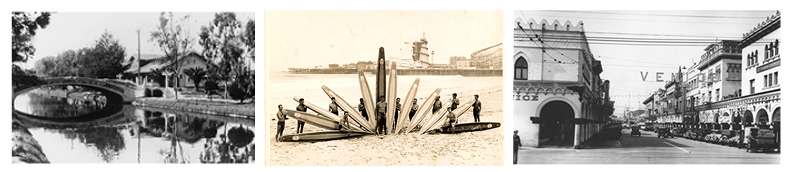
After his marriage in 1884, Kinney began purchasing land to the south with Francis Ryan. The partners developed Ocean Park with a walk pier and a country club. A streetcar line was extended to the site. After Ryan's untimely death in 1898, and a succession of partners with whom Kinney couldn't agree, it was decided that the land speculator would toss a coin and the winner would choose which half of the district would be his. When Kinney won the toss, he startled the other four partners by choosing the barren, marshy property. Kinney soon announced that his sand dunes and marshland would soon be a cultural city patterned after Venice, Italy. The public laughed and dubbed the plan "Kinney's Folly". They stopped laughing when trenches for canals were dug and Venetian-patterned buildings began to spring up. By July 4, 1905, Venice-of-America officially opened with a wonderful pier and exciting attractions: Italian gondoliers poling their boats down fairy-lit canals, a concert orchestra supplying music that could be heard nearly all over town, camel rides, exotic hotels catering to the best tastes and a miniature railroad circling the entire scene. The cultural diversion never flourished in Venice. The public came to ride the camels and the little train and to see the sideshow. The Doge of Venice-of America had built a cultural Renaissance by the sea. This atmosphere still prevails today. ~~~ Sign up to receive email updates from VHS. |











|
|
